September 16, 2026
What Happens When Building Software Becomes as Easy as Explaining an Idea?
Tikka Burrito is built around the idea that software creation should feel like a conversation. Users can explain what they want through prompts, voice, phone calls, or WhatsApp, while AI helps clarify the requirements, build the website or app, and move it toward a live product. This conversational, no-code approach makes software creation more accessible to non-technical founders and small businesses.
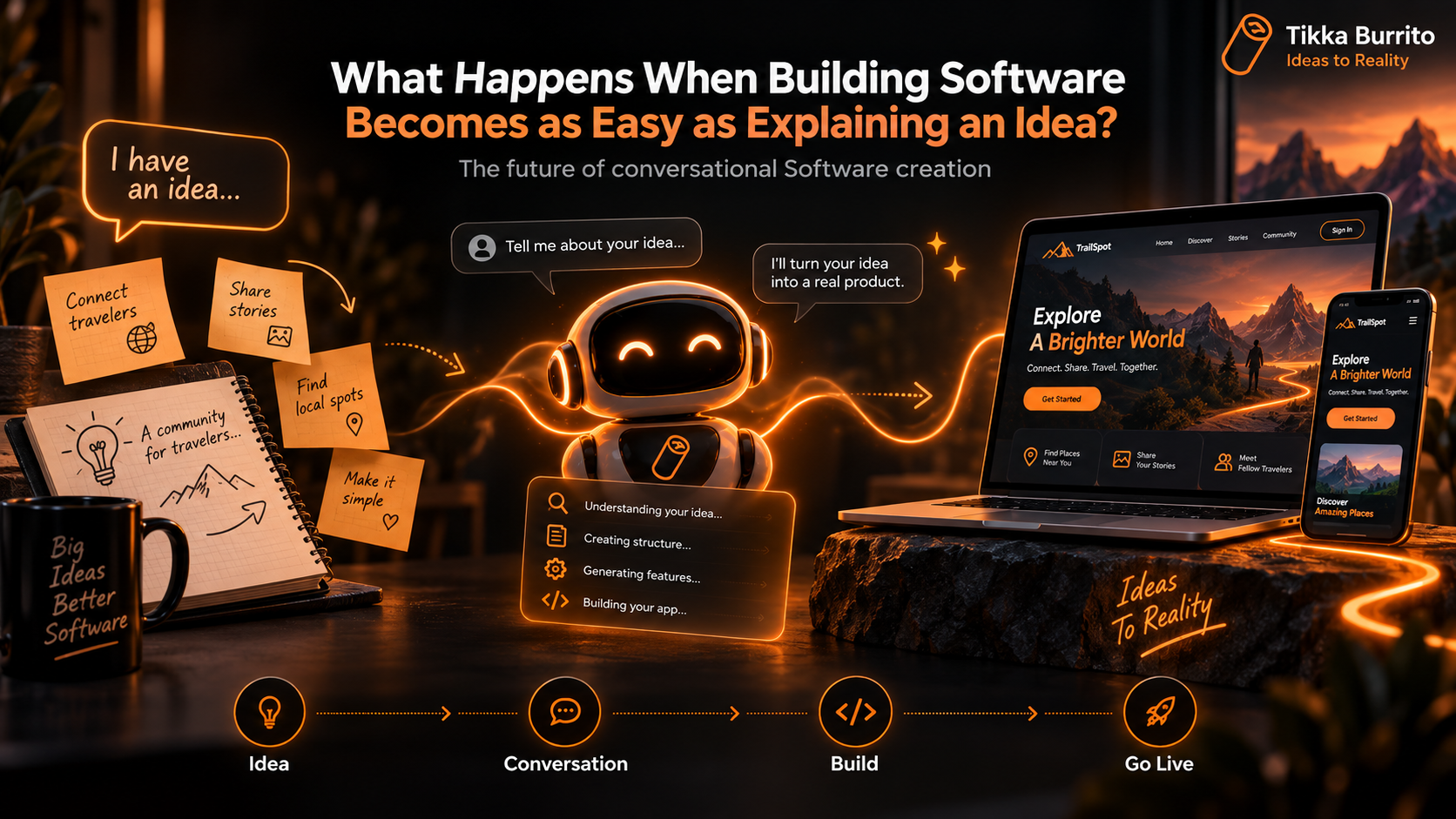
Most people already know how to explain what they want. The real difficulty begins when that idea has to become a website, an app, or a working digital product. Traditionally, that meant finding a developer, preparing requirements, waiting for designs, reviewing builds, and understanding at least some technical language along the way.
AI is changing that process. Instead of starting with code or a complicated software tool, people can begin with natural language. They can explain the problem, describe the customer, talk through the idea, and let AI help turn those thoughts into something real. This is the core vision behind Tikka Burrito: making software creation feel as natural as having a conversation. From Coding to Conversational Software Development Software development has always required people to translate their ideas into a format technology can understand. Traditional developers used programming languages. No-code platforms replaced much of that coding with visual editors and drag-and-drop tools. More recently, AI website builders and AI app builders introduced prompt-based development, allowing users to describe what they wanted in plain language. That was a major step forward, but most AI builders still depend heavily on the quality of the prompt. Users are often expected to know exactly what features they need, how the product should work, and how to describe those requirements clearly. For a non-technical founder or small-business owner, that can still feel complicated. The Idea Does Not Have to Be Perfect Real ideas usually start incomplete. Someone might simply say, “I want to build something that helps people find local fitness trainers.” That is not a complete product specification, but it is enough to begin a useful conversation. A conversational AI system can then ask practical questions such as: - Should trainers create their own profiles? - Can users search by location or specialty? - Should customers book sessions online? - Will trainers set their own prices? - Should the platform include ratings and reviews? Each answer makes the idea clearer. Instead of forcing the user to create the perfect prompt, conversational AI development helps discover the requirements naturally. The Tikka Burrito Approach: Explain First, Build Next Tikka Burrito is designed around a simple principle: users should not have to learn how to communicate with software before they can build software. They should be able to explain what they want in the same way they would explain it to another person. That is why Tikka Burrito supports multiple ways to start. Users can type a prompt, speak directly through web voice, make a phone call, or communicate through WhatsApp text and voice notes. The method may change depending on the user, but the goal is the same—understand the idea and help turn it into a real product. More Than Just Turning Voice Into Text Voice alone is not enough. A basic speech-to-text tool can convert spoken words into written text, but it cannot necessarily understand what is missing from the idea. Tikka Burrito is built to go further by helping clarify the requirements. If someone says, “I need a website for my catering business,” the AI can ask whether the business handles weddings, corporate events, or private parties. It can ask whether customers need pricing, menus, inquiry forms, WhatsApp contact, or photo galleries. The process becomes: Explain the idea → Clarify the requirements → Build the product → Deploy it live That is the difference between simply generating something from a prompt and creating a more complete conversation-to-product experience. What Changes When Software Becomes Easier to Build? When the barrier to software creation becomes lower, more people can participate. The biggest opportunity is not only for developers. It is for small-business owners, freelancers, creators, consultants, solo founders, and people who have valuable ideas but little technical experience. A restaurant owner may understand exactly how customers order food. A consultant understands how clients discover and book services. A photographer understands how customers choose packages. These people already understand the business problem. They should not also need to become experts in web development just to create a useful digital experience. Non-Technical Founders Can Test Ideas Faster One of the biggest advantages of AI-powered no-code development is speed. In the past, a founder might spend weeks finding developers, preparing specifications, reviewing designs, and waiting for the first usable version of an MVP. With an AI MVP builder, the journey from idea to testable product can become much shorter. A founder can explain the concept, refine the requirements through conversation, build an early version, and start showing it to real users. That does not mean every AI-generated product will be perfect immediately. Software still needs testing, feedback, and iteration. The difference is that users can reach the first real version much faster. Small Businesses Can Build Around Real Problems Small businesses often need simple but very specific digital tools. A salon may need online appointments. A restaurant may need a menu and reservation experience. A local service business may need lead forms, pricing information, and WhatsApp contact. A coach may need a landing page and booking system. These needs are often straightforward, but traditional custom development can still be expensive or time-consuming. AI website builders, AI app builders, and conversational software tools can make those solutions more accessible. The Future of Development Is Multimodal The future of software creation is unlikely to belong to one interface. Some people will prefer typing. Others will prefer voice. Some users will want to make a phone call while they are moving, while others will naturally use WhatsApp because that is already where they run parts of their business. Tikka Burrito is built around this flexibility. Instead of requiring everyone to work through a single prompt box, users can choose the communication method that fits the moment. Build in the Way That Feels Natural A founder might begin by brainstorming through voice, send additional details through WhatsApp later, type a precise change on a laptop, and return to voice when discussing a new feature. The software should be able to support that journey instead of forcing the user into one rigid workflow. This is where multimodal AI, mobile-first development, voice AI, WhatsApp website building, and conversational app development begin to come together. The future may look less like “learning a website builder” and more like simply saying what you want to accomplish. From “I Have an Idea” to “Here’s the Live Link” The most important change is not that AI can generate code faster. It is that the distance between an idea and a real product is becoming smaller. Someone can begin with a simple thought: “I want a website where customers can book my service.” The AI can ask what services are offered, understand how bookings should work, identify what information customers need, create the website, and help move it toward deployment. That journey can eventually become: I have an idea → Let’s talk about it → Let’s build it → Here’s the live link This is the broader vision behind Tikka Burrito. Software creation should not be limited to people who know programming languages, understand complicated development tools, or know how to write perfect AI prompts. If someone understands a problem and can explain the solution they imagine, that should be enough to start building. When creating software becomes as easy as explaining an idea, more people can turn their knowledge, businesses, and creativity into real digital products. And that is where the future of conversational AI development becomes truly interesting.