September 20, 2026
Why Conversation Can Lead to Better Website Requirements
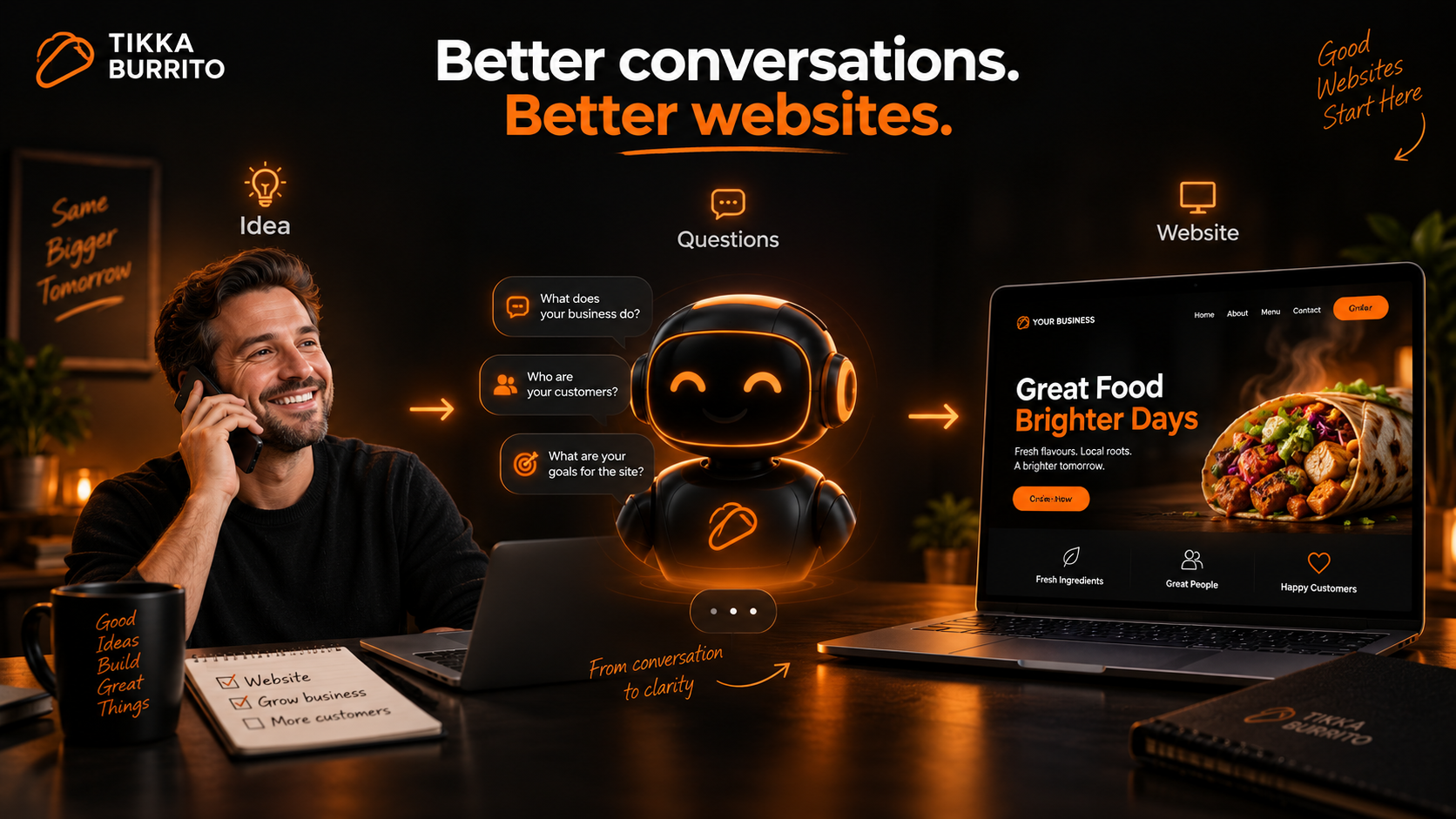
Conversation can lead to better website requirements because it gives AI the chance to ask questions, uncover missing details, and understand the real business goal before generation begins. Tikka Burrito uses conversational AI across phone calls, web voice, text, and WhatsApp to help users clarify requirements and create more relevant websites with less guesswork and rework.
Why Conversation Can Lead to Better Website Requirements
A website can look modern and still fail to do its job. That usually happens when the design starts before the real requirements are clear. If an AI website builder only receives a short prompt like “build me a website for my business,” it has to make assumptions about the audience, services, features, content, and calls to action.
Conversation changes that. Instead of jumping straight into generation, AI can ask questions, understand the business, and clarify what the website actually needs. That often leads to clearer website requirements, fewer assumptions, and a better final result.
Better Websites Start With Better Questions
The quality of a website often depends on the quality of the information available before the build begins. A business owner may know exactly how their company works, but they may not know how to translate that knowledge into a website specification.
For example, someone might say, “I need a website for my salon.” That sounds simple, but the right website depends on many details. Does the salon need online booking? Should pricing be visible? Are there different services for hair, beauty, or bridal packages? Do customers usually contact the business through WhatsApp? Should the website showcase previous work?
These questions help turn a broad idea into useful requirements. A conversational AI website builder can make that discovery process feel natural instead of forcing the user to create a long technical brief.
AI Questions Can Reveal What the User Forgot to Mention
People often leave out important details simply because those details feel obvious to them. A restaurant owner may forget to mention that most customers order through WhatsApp. A coach may forget to say that consultations are free. A photographer may assume that a gallery is essential without explicitly requesting one.
AI can help uncover those missing details by asking focused questions such as:
Who is the website for? What should visitors do first? Which services or products matter most? Do you need booking, payments, forms, or WhatsApp contact? Should pricing be shown? What style should the website have?
These questions reduce guesswork and give the AI stronger information to work with.
Clear Requirements Create Better AI-Generated Websites
When requirements are unclear, AI has to fill in the gaps. That can lead to generic sections, unnecessary features, or a website that looks good but does not match the business.
Clearer requirements make the output more relevant. If the AI understands the audience, it can write better copy. If it understands the main business goal, it can create stronger calls to action. If it knows how customers normally contact the business, it can design the right conversion path.
Requirements Influence the Whole Website
Good requirements affect more than just features. They shape the entire website experience.
They help define:
Structure: which pages and sections are needed Content: what the website should say Design: what tone and style fit the business Functionality: booking, forms, payments, galleries, WhatsApp, or other tools Conversion: what action visitors should take User experience: how easily customers can find what they need
This is why requirements before generation can make such a big difference. The AI is not simply creating something attractive. It is building around a clearer understanding of the business.
How Tikka Burrito Uses Conversation Before Building
Tikka Burrito is designed around the idea that users should not need to arrive with a perfect website brief. They can begin with a simple explanation of what they want and let the conversation develop from there.
Users can start through a phone call, web voice, text prompt, or WhatsApp text and voice notes. The input method can change, but the goal is the same: understand the idea before building.
From a Simple Idea to Clear Website Requirements
Imagine a small-business owner says, “I need a website for my home cleaning company.”
Instead of immediately generating a generic cleaning website, Tikka Burrito can help clarify the real needs. The AI can ask which locations the company serves, what types of cleaning are offered, whether pricing should be shown, whether customers should book online, and whether WhatsApp or phone calls are the preferred contact method.
That conversation gradually turns a simple idea into a clearer set of requirements.
The process becomes:
Explain → Ask → Clarify → Build
This approach helps reduce assumptions before generation begins.
Conversation Can Reduce Rework
One of the biggest problems with building too quickly is rework. If the AI misunderstands the business at the beginning, the user may spend a lot of time correcting the website later.
The wrong call to action has to be changed. Missing services have to be added. Unnecessary sections have to be removed. The tone may need rewriting. The whole structure may need to be reorganized.
A short conversation before building can prevent some of that.
Better Understanding Means a Better First Version
The first version of any website may still need improvements, but better requirements can make that first version much closer to the user's expectations.
This matters especially for small-business owners and non-technical founders who want to move quickly without spending hours fixing misunderstandings.
Instead of:
Prompt → Generate → Correct → Rewrite → Rebuild
the workflow becomes:
Conversation → Clarify → Generate → Refine
That is usually a more efficient starting point.
Why This Matters for Non-Technical Users
Non-technical users often know more about their business than any website builder ever could. They understand their customers, services, pricing, and common questions. The challenge is expressing that knowledge in a format software can use.
Conversation helps bridge that gap.
A user does not need to say, “Create a conversion-focused hero section with an integrated booking CTA.”
They can simply say, “I want visitors to understand what I offer quickly and book a consultation.”
The AI can translate that business language into website structure and functionality.
You Know the Business — AI Can Help With the Website
That is one of the main advantages of conversational AI. It allows the user to stay focused on the business while AI handles more of the technical interpretation.
For small businesses, freelancers, creators, and first-time founders, this can make AI website building and no-code development feel much more approachable.
You do not need to become a designer or developer first. You need to explain what your customers need.
Better Conversations Can Lead to Better Outputs
AI website builders are becoming incredibly fast, but faster generation is not always the same as better generation. If the goal is to create a useful website, understanding should come before speed.
Conversation gives AI more context. Better context creates clearer requirements. Clearer requirements can lead to more relevant design, content, features, and calls to action.
That is why Tikka Burrito focuses on conversation as part of the building process.
The idea is not to slow users down with endless questions. It is to ask the right questions early enough to avoid bigger problems later.
A few minutes of clarification can make the difference between a generic AI-generated website and one that actually fits the business.