September 11, 2026
From Conversation to Product: The Idea Behind Tikka Burrito
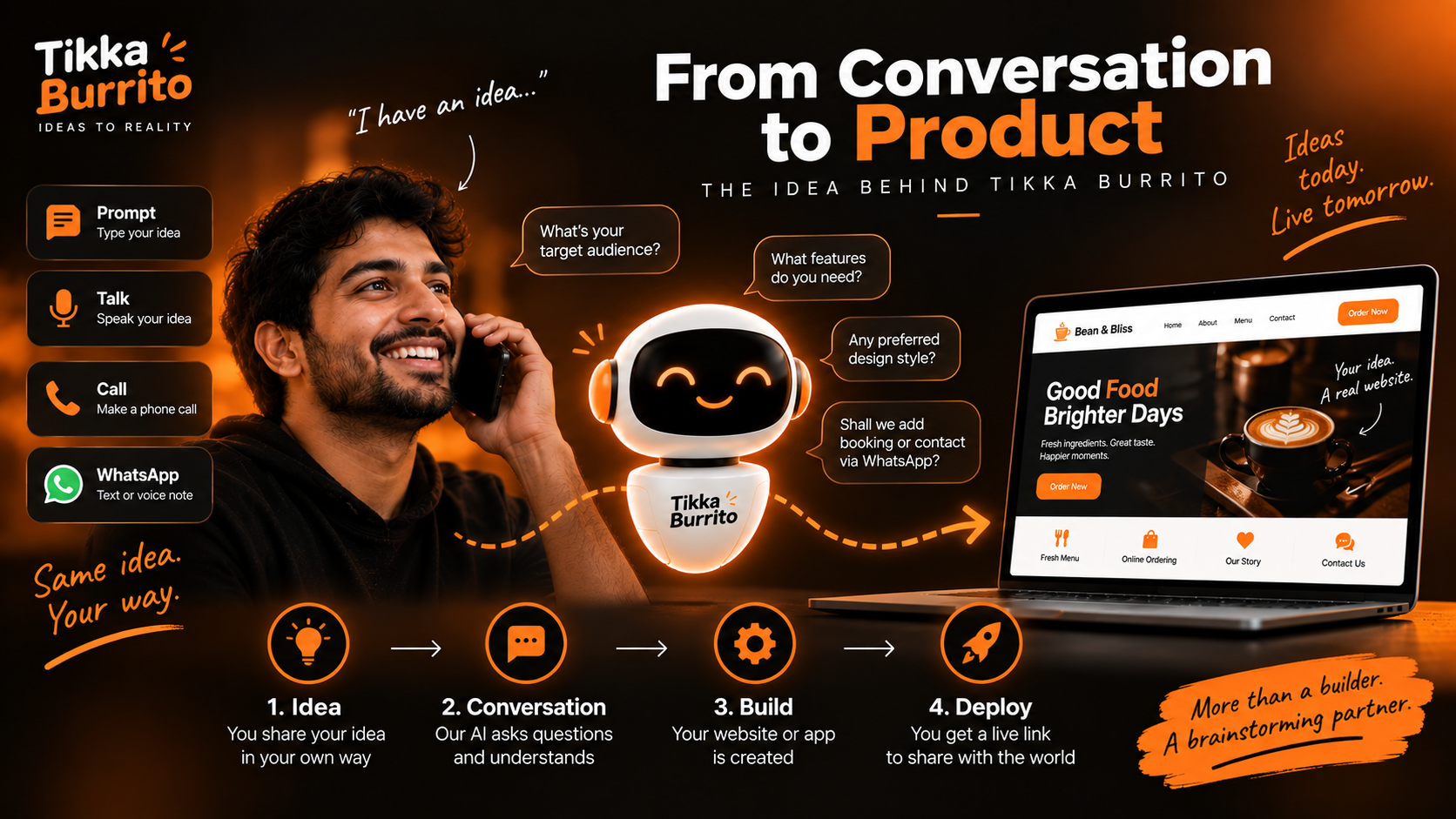
Tikka Burrito is built around a simple idea: software creation should begin as naturally as ideas do—with a conversation. Through prompts, web voice, phone calls, WhatsApp text, and voice notes, users can explain what they want while AI helps clarify requirements, build the website or app, and move it toward a live product. The goal is to make AI-powered software development more conversational, mobile-first, multilingual, and accessible to non-technical founders and small businesses.
Most software products begin with something surprisingly simple: a conversation. A founder tells a friend about an idea. A restaurant owner explains a problem customers keep facing. A small-business owner says, “I wish I had a website that could do this.” Long before there is a design, database, or line of code, there are usually just words.
Yet when it is time to actually build, that natural conversation often disappears. The idea has to become a technical brief, a collection of wireframes, developer requirements, or increasingly, a carefully written AI prompt. Tikka Burrito started with a different question: what if the conversation itself could become the starting point for building software?
That idea is at the heart of Tikka Burrito—a conversational AI website and app builder designed to help people move from an unfinished idea to a real, live product without needing to become developers first.
Why Software Creation Should Feel More Like a Conversation
The rise of no-code development made software creation significantly more accessible. People who couldn't program could suddenly create websites using templates, visual editors, and drag-and-drop components. More recently, AI website builders, AI app builders, and vibe coding tools introduced another major change: instead of manually creating everything, users could describe what they wanted in natural language.
But there is still a gap. Most AI builders work best when the person already knows exactly what they want. The user types a prompt, the AI generates something, and the user keeps adding instructions until the result gets closer to the original idea.
Real ideas rarely develop that neatly.
Great Ideas Usually Start Half-Finished
A founder might begin with, “I want to build something that helps people find local fitness trainers.” That isn't a complete product specification, but it is enough to start a useful conversation. Should trainers have profiles? Should customers search by location? Will users book sessions through the platform? Should trainers set their own prices? Does the product need reviews?
Each question makes the idea clearer.
This is why conversational software development can be different from simple prompt-to-app generation. Instead of expecting the user to provide every requirement upfront, AI can participate in discovering what should be built.
For non-technical founders, that is especially valuable. They can focus on the problem, customer, and business idea while AI helps translate those thoughts into product requirements.
The Idea Behind Tikka Burrito: Talk First, Build From There
Tikka Burrito was built around a simple belief: people shouldn't have to learn a new way of communicating just because they want to create software. If you can explain your idea naturally, that should be enough to begin.
Sometimes that means typing a prompt. Other times it means speaking through web voice, making a phone call, or sending a WhatsApp message or voice note. The communication method can change, but the underlying experience remains conversational.
Tikka isn't intended to simply take those words and transcribe them into one giant prompt. The AI can engage with the idea, ask useful questions, understand requirements, and help refine what the user actually wants to create.
More Than “Tell AI What to Build”
Imagine someone saying, “I need a website for my catering business.”
A basic AI website generator could immediately produce a generic catering website. But there are important questions that could dramatically change the result. Does the business cater weddings, corporate events, or private parties? Should visitors see menus and pricing? Do customers need to request a quote? Should inquiries go through a form, phone call, or WhatsApp? Does the owner want to showcase previous events?
The goal of Tikka Burrito is to make those questions part of the building experience.
The journey becomes:
Idea → Conversation → Requirements → Build → Deployment
Instead of forcing the user to become a product manager before using an AI builder, the conversation helps uncover the product along the way.
From Phone Calls and WhatsApp to a Real Product
How people communicate has changed dramatically, but most software development tools are still designed around a laptop. That makes sense for professional developers, but it doesn't necessarily make sense for everyone who wants to create software.
Small-business owners already run significant parts of their businesses through their phones. Founders brainstorm while traveling. Entrepreneurs send voice notes when typing would take too long. WhatsApp is already used for customer communication, sales, support, and day-to-day business operations.
So why shouldn't software creation happen there too?
Build in the Way That Feels Natural
Tikka Burrito supports different ways of starting and continuing the creation process. A user can type a prompt when they know exactly what they want, talk through web voice when explaining an idea is easier, make a phone call when they are away from a computer, or use WhatsApp text and voice notes as part of a familiar mobile workflow.
This multimodal approach makes AI-powered software creation less dependent on one interface. A founder could start by talking, clarify something later through text, and continue refining the product as the idea evolves.
Voice and WhatsApp also create opportunities for mobile-first and multilingual AI development. Someone shouldn't need to be comfortable writing long technical prompts in English just to create a digital product. The closer AI gets to understanding natural conversation across languages and communication styles, the more accessible software creation becomes.
Turning Conversation Into Something People Can Actually Use
Generating ideas is easy. Generating code is becoming easier too. The harder and more valuable part is turning those ideas into something real enough for another person to use.
That's why the Tikka Burrito vision doesn't end with conversation.
Once the AI understands the requirements, it can move toward creating the actual website or application, assembling the necessary experience, and deploying the product with a live link. For a small-business owner, that live link could become the website they send to customers. For a founder, it could become the first version of an MVP used to test an idea.
From “Someday” to a Testable MVP
Traditionally, someone with a software idea might spend weeks documenting it, finding a developer, discussing cost, waiting for designs, reviewing development, and finally reaching something they could test.
AI MVP builders and no-code AI development are compressing that cycle.
This doesn't mean every conversation instantly becomes a perfect production application. Building useful software still requires clear thinking, iteration, testing, and refinement. What AI can change is how quickly someone reaches the first real version.
That matters because ideas become much easier to evaluate once they exist outside your head.
Instead of spending months wondering whether customers will want something, a founder can work toward building it, sharing it, learning from users, and improving it.
Making Software Creation More Human
The bigger idea behind Tikka Burrito isn't simply voice coding or building websites through phone calls. Those are ways of reaching a broader goal: making the interaction between humans and software creation feel more natural.
Coding required humans to learn the language of computers. No-code replaced much of that language with visual interfaces. AI development introduced natural-language prompts. Conversational AI can take another step by allowing the system to participate in the thinking process rather than simply waiting for commands.
For the person building, the experience can become less about operating a development tool and more about developing an idea.
Conversation Could Become the New Interface
The future of software building probably won't belong exclusively to prompts, voice, WhatsApp, or traditional coding. Different people will prefer different interfaces, and even the same person may want different methods at different moments.
What matters is reducing the distance between “I have an idea” and “I built something people can use.”
That's the idea behind Tikka Burrito.
Start with the thought in your head. Explain it naturally. Let AI ask questions. Shape the requirements together. Build the product. Put it online. Then keep improving it.
Software creation doesn't always have to begin with code.
Sometimes, it can begin with a conversation.