September 10, 2026
What If You Could Build a Website With a Phone Call?
Phone-call website building combines conversational AI, no-code development, and AI website generation to make software creation more natural. Instead of writing complex prompts or learning technical tools, users can explain their idea through a phone call, answer a few questions, and let AI turn the conversation into a live website. Tikka Burrito brings this experience together with phone calls, voice, prompts, and WhatsApp to help non-technical founders and small businesses build more easily.
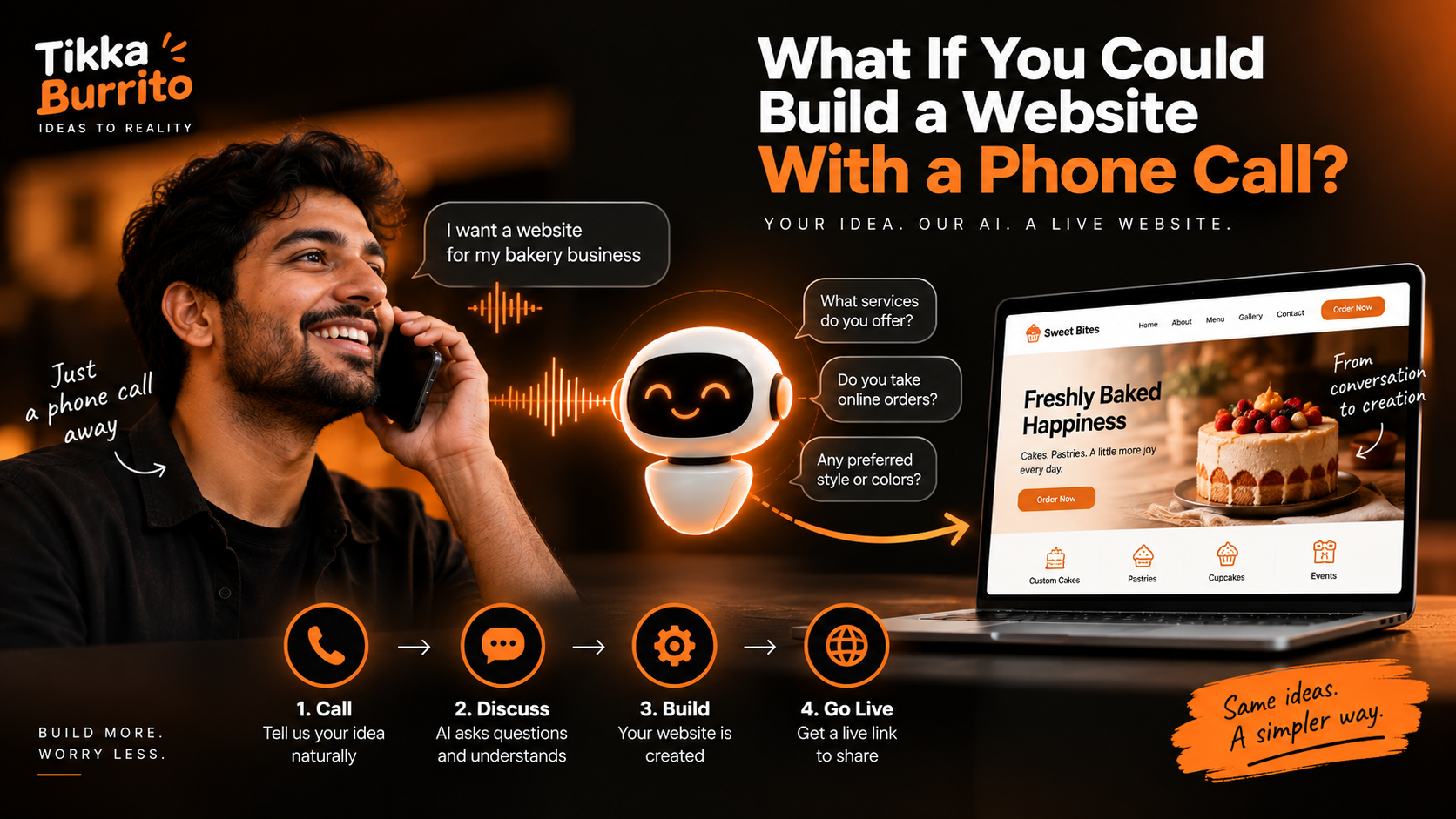
What If You Could Build a Website With a Phone Call?
Building a website has become easier over the years, but it still usually starts the same way: open a laptop, choose a tool, type a prompt, select a template, or explain your requirements to a developer. For many small-business owners and non-technical founders, that process can still feel like work before the real work even begins.
Now imagine a different experience. You pick up your phone, call an AI, explain your idea naturally, answer a few questions, and the system turns that conversation into a real website. No coding. No complex prompt writing. No need to understand design systems, hosting, or development frameworks.
That is the idea behind phone-call website building: making website creation feel less like using software and more like having a conversation.
From Website Builders to Conversational AI
Traditional website development required technical skills such as HTML, CSS, JavaScript, hosting, and deployment. No-code website builders made this easier by introducing templates and drag-and-drop editors. AI website builders pushed things further by allowing users to describe what they wanted through text prompts.
But even prompt-based tools still expect users to know how to explain their idea clearly in writing. That can be difficult when the idea is still forming.
A conversational AI website builder changes the interaction. Instead of forcing the user to prepare a perfect prompt, it can ask questions and help shape the website as the conversation develops.
For example, a small-business owner could say, “I run a home cleaning service and I want a website where customers can understand our services and contact us.”
The AI might then ask whether customers should book directly, what cities the business serves, whether prices should be shown, and whether WhatsApp or phone calls should be the main contact method.
That is much closer to working with a real person than filling out a website form.
How a Phone Call Can Become a Website
The process sounds simple, but there are several steps happening behind the scenes. The voice conversation needs to be understood, important requirements need to be identified, missing details need to be clarified, and those business needs need to be translated into a real website.
A phone-call website builder can make this flow much easier for the user.
1. Explain the Idea Naturally
The first step is simply talking.
You do not need to know technical terms or prepare a detailed website brief. You can explain your business in everyday language.
You might say, “I have a photography business. I mostly do weddings and family shoots. I want a clean website where people can see my work, understand the packages, and contact me.”
That gives the AI enough context to begin understanding the purpose of the site.
2. AI Clarifies the Requirements
The AI can then identify what is missing.
Should customers book sessions online? Do you need a gallery? Should pricing be shown publicly? Do you want testimonials? Is there a particular style or color you prefer?
This step is important because a good voice AI website builder should not simply transcribe your words. It should help convert a rough idea into clear website requirements.
3. AI Builds the Website
Once the requirements are understood, the AI can begin generating the website structure, content, design, and functionality.
That might include a homepage, services section, about page, contact form, booking experience, pricing section, testimonials, and mobile-responsive design.
The user stays focused on the business. The AI handles more of the technical process.
4. The Website Goes Live
The most useful outcome is not just generated code. It is a live website that can actually be shared.
This is where AI website building with deployment becomes valuable. Instead of ending with a draft or preview, the process can continue until the website is published and ready for customers.
Why Phone-Call Website Building Matters
The biggest advantage is not simply speed. It is accessibility.
Many people have strong business ideas but do not consider themselves technical. A restaurant owner, consultant, therapist, local service provider, coach, freelancer, or first-time founder may understand their customers extremely well but know very little about web development.
A no-code AI website builder gives those users a way to create without needing to become developers.
Phone calls make that experience even more natural because speaking is already familiar. There is no new interface to learn.
No Prompt Engineering Required
One of the hidden barriers in AI tools is the pressure to write the right prompt.
Users often feel they need to create long, highly detailed instructions to get a useful result. That creates another learning curve.
With conversational AI, the burden shifts away from the user. You do not need to think, “How should I phrase this for the AI?”
You can simply explain what you want.
The AI can ask follow-up questions and help organize the details.
Build Without Being Tied to a Laptop
Phone-based website creation also supports a more mobile-first way of working.
A founder might get an idea during a commute. A shop owner might realize they need a promotional page while standing inside the store. A freelancer could think through a new service while walking.
Instead of waiting until later, they can begin immediately.
That makes build website from phone, mobile-first AI development, and voice-to-website technology more than just convenience features. They change when and where creation can happen.
How Tikka Burrito Approaches Phone-Call Website Building
Tikka Burrito is designed around the idea that users should be able to build software in the way that feels most natural to them.
That includes traditional prompts, web voice, phone calls, WhatsApp text, and voice notes.
The important part is that Tikka does not simply listen and transcribe. It is designed to have a conversation, ask useful questions, understand the business requirements, help refine the idea, build the website or app, and deploy it with a live link.
This creates a more complete conversation-to-product experience.
A user might begin with something simple like, “I want a website for my catering business.”
From there, the AI can help determine what the site actually needs.
Should customers request quotes? Should menus be downloadable? Should events and packages be displayed? Should people contact the business through WhatsApp? Does the owner need an image gallery?
The website becomes more useful because the requirements are discovered through conversation instead of guessed from a one-line prompt.
The Future of No-Code May Be a Conversation
No-code development was created to remove the need for programming. AI website builders reduced the need for manual design. Conversational AI could remove another barrier: the need to understand how website-building tools work at all.
The future may not be one single interface.
Sometimes users will want to type. Sometimes they will want to speak through web voice. Sometimes they will send a WhatsApp message. And sometimes the easiest thing will simply be making a phone call.
What matters is that the AI understands the idea regardless of how it is communicated.
A website builder should not force everyone into the same workflow. It should adapt to the user.
That is what makes phone-call website building interesting. The real innovation is not the call itself. It is the possibility of turning natural conversation into a real digital product.
You explain the idea. The AI asks questions. The requirements become clear. The website is built. And the final result is something you can actually share.
That is a much more human way to build.