September 9, 2026
Prompt, Talk, Call, or WhatsApp: Build Software Your Way
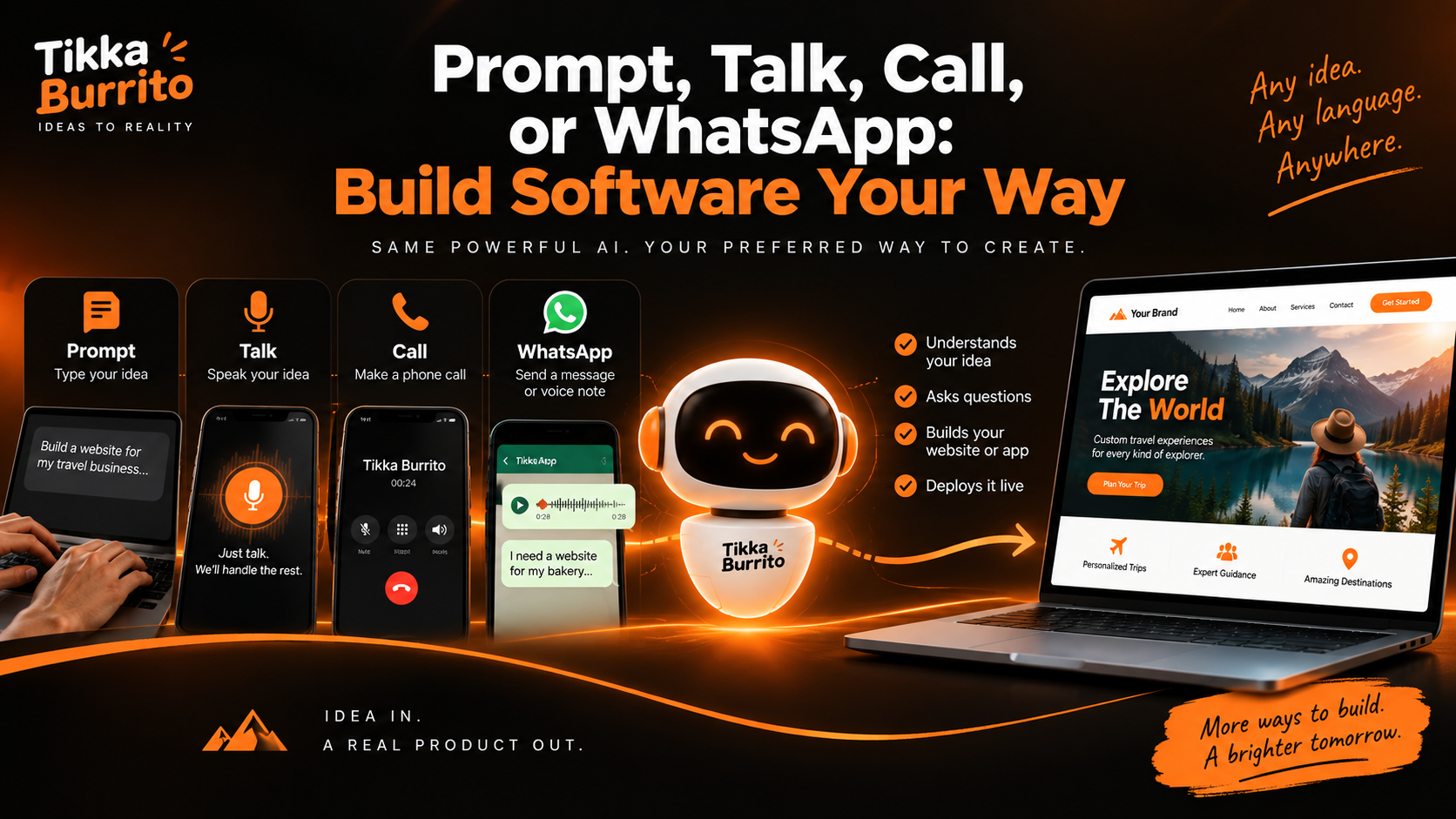
Tikka Burrito makes AI-powered software creation more flexible by allowing users to build through prompts, web voice, phone calls, WhatsApp text, and voice notes. Instead of forcing everyone into a single workflow, its conversational approach helps understand ideas, clarify requirements, build websites or apps, and turn conversations into live products.
Prompt, Talk, Call, or WhatsApp: Build Software Your Way
For a long time, building software meant adapting yourself to the tools. Developers learned programming languages, businesses learned website builders, and the no-code era introduced visual editors. More recently, AI website builders and AI app builders made things easier by allowing people to describe what they wanted through prompts. Yet there is still one limitation: most tools expect everyone to communicate with AI in roughly the same way.
People don't naturally work like that. Sometimes typing is easiest. Sometimes an idea is much easier to explain by talking. A business owner may prefer sending a WhatsApp message, while a founder on the move may simply want to make a phone call. Conversational AI development creates a different possibility: instead of changing how you communicate to fit the software, the software can adapt to how you naturally communicate.
One Idea, Different Ways to Build It
Think about how we communicate with people every day. We might send a quick text when the message is simple, leave a voice note when there is more to explain, or make a phone call when we want to discuss something properly. There is no reason AI-powered software development has to be limited to a single prompt box.
Tikka Burrito is built around this idea. Users can type a prompt, speak directly with AI through web voice, make a phone call, or communicate through WhatsApp text and voice notes. Whichever method you choose, the goal remains the same: explain what you want to create in the way that feels most natural to you.
Prompt When You Know Exactly What You Want
Sometimes typing is still the fastest option. If you already have a clear idea, you might write, “Build a modern landing page for my fitness coaching business with services, testimonials, pricing, and a consultation form.” An AI website builder can take those requirements and begin creating the product.
Text is particularly useful for precise changes and detailed instructions. The difference with a multimodal AI builder is that typing isn't the only way to begin. You can move between different forms of communication depending on what you're doing.
Talk When Your Idea Needs a Conversation
Ideas don't always arrive as perfectly organized specifications. You may know the problem you want to solve but still be figuring out the product itself. Talking can make that process much more natural.
With voice AI and conversational website building, you can explain the idea in your own words. The AI can understand the context, ask useful follow-up questions, and help clarify what should actually be built. Instead of spending time trying to create the perfect prompt, you can develop the requirements through conversation.
Make a Phone Call and Build From Anywhere
Software development has traditionally been tied to a desk. Even many modern no-code development platforms and AI coding tools assume you have a laptop open in front of you. But entrepreneurs and small-business owners don't spend their entire day sitting behind a computer.
A phone-based AI builder changes that starting point. You could discuss a new landing page while walking, explain an MVP during your commute, or talk through a business website when you're away from your laptop. The phone becomes more than a device for checking the finished product—it becomes a way to start creating it.
AI That Talks Back Instead of Simply Listening
The important part of a phone call isn't simply converting your voice into text. If the system only transcribes everything you say and turns it into one large prompt, the experience is still fundamentally prompt-based.
Tikka Burrito takes a conversational approach. If you say you want a website for a home-cleaning business, the AI can help uncover details that weren't included initially. Should customers book services online? Which areas does the business serve? Are there different cleaning packages? What should visitors do when they arrive on the homepage?
That process turns voice-to-website development into a conversation about the business rather than a dictation exercise.
Build Through WhatsApp and Voice Notes
For millions of people, WhatsApp is already one of the most natural ways to communicate. People use it to talk with customers, coordinate businesses, share photos, send documents, and leave voice notes. Bringing AI website and app development into WhatsApp can make software creation feel much more familiar.
Imagine having an idea while running your business and sending a voice note explaining it. Later, you remember another requirement and send a text. Instead of waiting until you're at a computer to rewrite everything into a structured development prompt, the conversation itself can become part of the building process.
Mobile-First and Multilingual Software Creation
WhatsApp and voice also open an important door for people who are more comfortable speaking than typing, especially when English isn't their first language. Multilingual AI development can allow someone to explain a business idea more naturally instead of struggling to translate their thoughts into technical English.
This matters for small businesses, first-time founders, creators, freelancers, and entrepreneurs around the world. The future of no-code AI development shouldn't be limited to people who know programming terminology or are skilled at prompt engineering. If someone understands their business and can explain what they need, that should be enough to start building.
From Conversation to a Live Product
Whether the idea begins as a typed prompt, web voice conversation, phone call, WhatsApp message, or voice note, the input method is only the beginning. What matters is what happens next.
Tikka Burrito is designed to understand the idea, ask relevant questions, refine the requirements, build the website or application, and move toward deployment with a live link. This creates a more complete journey from idea to website, idea to app, or idea to MVP, rather than stopping after generating a piece of code.
Build Software the Way You Naturally Communicate
There probably isn't one perfect interface for building software. A founder might prefer voice when brainstorming and text when making precise changes. A shop owner may live inside WhatsApp. Someone traveling may want to make a phone call, while another user may prefer the familiar prompt experience of an AI app builder.
That's why the future of AI development may be less about finding one new interface and more about removing the interface barrier altogether.
Prompt when you want to type. Talk when you want to brainstorm. Call when you're on the move. Use WhatsApp when that's where you already communicate.
The technology should adapt to you—not the other way around.
As AI website builders, AI app generators, vibe coding tools, no-code platforms, voice AI, and conversational AI continue to evolve, building software could become less like operating a development tool and more like explaining an idea to someone who knows how to make it real.
For non-technical founders and small businesses, that could be one of the biggest changes of all: you don't have to become a developer to build. You just need a way to communicate your idea.
Tikka Burrito is built around giving you that choice.