September 8, 2026
From Phone Call to Live Website: How AI Is Changing the Way We Build
AI is transforming website creation from a technical process into a conversation. With conversational AI, users can explain an idea through voice, clarify requirements, build a website or app, and move toward deployment without needing coding skills or complicated prompts. Tikka Burrito brings this approach to phone calls, web voice, text, and WhatsApp, making the journey from idea to live product more natural for founders and small businesses.
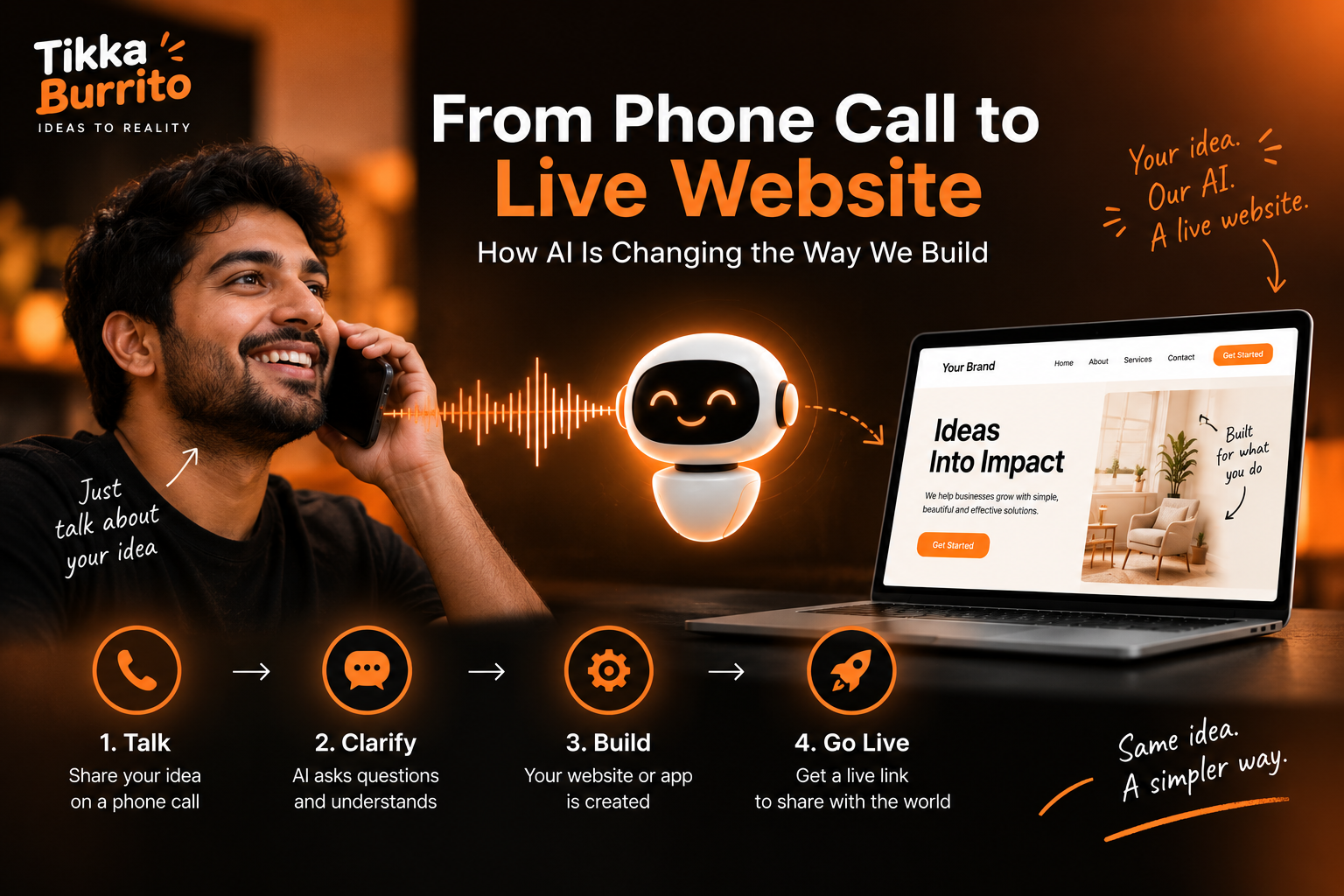
A great business idea can come at any time—during a commute, between customer meetings, while running a store, or even while taking a walk. Until recently, turning that idea into a real website meant opening a laptop, finding a website builder, choosing templates, writing content, or hiring someone to build it. Even with no-code tools, there was still a process to learn.
AI website builders are changing that. But the next step is even more natural: instead of typing long prompts, what if you could simply make a phone call, explain your idea, answer a few questions, and let AI turn the conversation into a live website? This shift from prompt-to-website to conversation-to-website could make building software accessible to far more people.
Building a Website Can Start With a Simple Conversation
Most people don't think about their business in technical terms. A restaurant owner isn't thinking about responsive layouts, navigation architecture, conversion-focused landing pages, or frontend frameworks. They might simply know, “I need a website where people can see our menu, find our location, and contact us on WhatsApp.”
A conversational AI website builder can start there. Instead of expecting the user to prepare a detailed specification, AI can listen to the idea and understand the business goal behind it. This creates a much more human way to approach website development without coding, especially for entrepreneurs who know their businesses well but don't know web development.
The AI Can Ask What You Forgot to Mention
Real conversations aren't one-way instructions. If you tell someone you need a website for your bakery, they might naturally ask whether you take custom cake orders, whether customers should order online, what areas you serve, or whether you want to showcase previous work. A useful voice AI website builder should be able to do something similar.
This is where conversational AI becomes more powerful than simple speech-to-text. Instead of only transcribing a phone call into a prompt, the AI can identify missing requirements, ask relevant questions, and help turn a rough idea into something more complete. For a non-technical founder, this means you don't necessarily need to know every feature before you begin.
From Voice to Requirements—and Requirements to a Real Website
Once the idea becomes clearer, AI can translate everyday language into website requirements. A request such as “I want customers to book appointments without calling me” can become a booking experience. “I want people to see what previous customers think” can become a testimonial section. “Most customers contact us on WhatsApp” can become a prominent WhatsApp call-to-action.
This is an important part of AI-powered website development. The user can stay focused on customers, services, and business goals while the AI handles more of the technical thinking behind pages, sections, functionality, content, and user experience.
Talk → Clarify → Build → Deploy
The entire process can become remarkably simple:
Talk: Explain the business, app, website, or idea naturally. Clarify: AI asks questions and understands the requirements. Build: The AI website builder creates the pages, content, design, and functionality. Deploy: The finished product is published and becomes a live website that can be shared.
That final step matters. Creating code or generating a preview is useful, but most small-business owners aren't looking for code. They want something customers can actually open and use. An AI website generator with deployment can reduce the distance between having an idea and putting a real product in front of people.
Why Tikka Burrito Is Building Around Conversation
This conversational approach is at the center of Tikka Burrito. The idea is simple: people shouldn't have to change the way they naturally communicate just because they want to create software. Some people prefer typing. Others find it easier to explain an idea aloud. And sometimes you're away from your laptop and your phone is the only thing you have with you.
With Tikka Burrito, users can type a prompt, talk directly through web voice, make a phone call, or communicate through WhatsApp text and voice notes. The AI is designed not just to receive instructions, but to have a conversation, ask useful questions, understand requirements, help refine the idea, build the website or app, and deploy it with a live link.
Built for People Who Don't Speak “Developer”
For non-technical founders and small-business owners, this can completely change the starting point. You don't need to know whether your website requires React, an API, a particular component library, or a specific development framework. You can describe what the business needs in your own words.
This also makes mobile-first and multilingual AI development especially interesting. Software creation has traditionally been centered around laptops, keyboards, technical terminology, and often English. Conversational AI creates the possibility of building in a much more accessible way—through the devices and languages people already use every day.
A More Human Future for Building Software
AI is making website and app development faster, but speed alone isn't the biggest change. The more meaningful shift is that the interface between an idea and software is becoming simpler. Coding made us communicate with computers through programming languages. No-code gave us visual interfaces. AI builders gave us prompts. Conversational AI may let us communicate with software builders the same way we communicate with another person.
That doesn't mean text prompts or visual editors will disappear. Someone might begin with a phone call, continue with a WhatsApp voice note, type a precise change later, and use a visual interface for final adjustments. The future of AI app building and no-code development is likely to be flexible rather than tied to one interface.
From “I Have an Idea” to “Here’s the Link”
For years, there was a large gap between those two sentences. An idea had to become requirements, requirements had to become designs, designs had to become code, and code had to be hosted and deployed. AI is beginning to compress that entire journey.
The exciting possibility isn't simply building websites by phone call. It's making software creation feel natural enough that someone who has never considered themselves technical can still turn an idea into something real.
You talk. The AI understands. Together, you clarify the idea. The product gets built. And instead of ending with a folder full of code, you end with something much more useful:
a live link.