September 7, 2026
Voice-to-Website: The Next Evolution of No-Code Development
Voice-to-website technology is making no-code development more natural by letting people build websites and apps through conversation. Instead of learning coding, complex tools, or perfect prompts, users can simply explain their idea, answer a few questions, and let AI turn those requirements into a live product. With voice, mobile, WhatsApp, and multilingual interaction, platforms like Tikka Burrito are helping make software creation faster, more accessible, and easier for non-technical founders and small businesses.
Voice-to-Website: The Next Evolution of No-Code Development
Building a website used to mean learning code, hiring a developer, or spending hours figuring out complicated design tools. No-code platforms made the process easier, and AI website builders pushed it even further by allowing people to generate websites from simple prompts. But there is still friction: you need to sit down, type instructions, explain every requirement, and often rewrite prompts until the AI understands what you actually want.
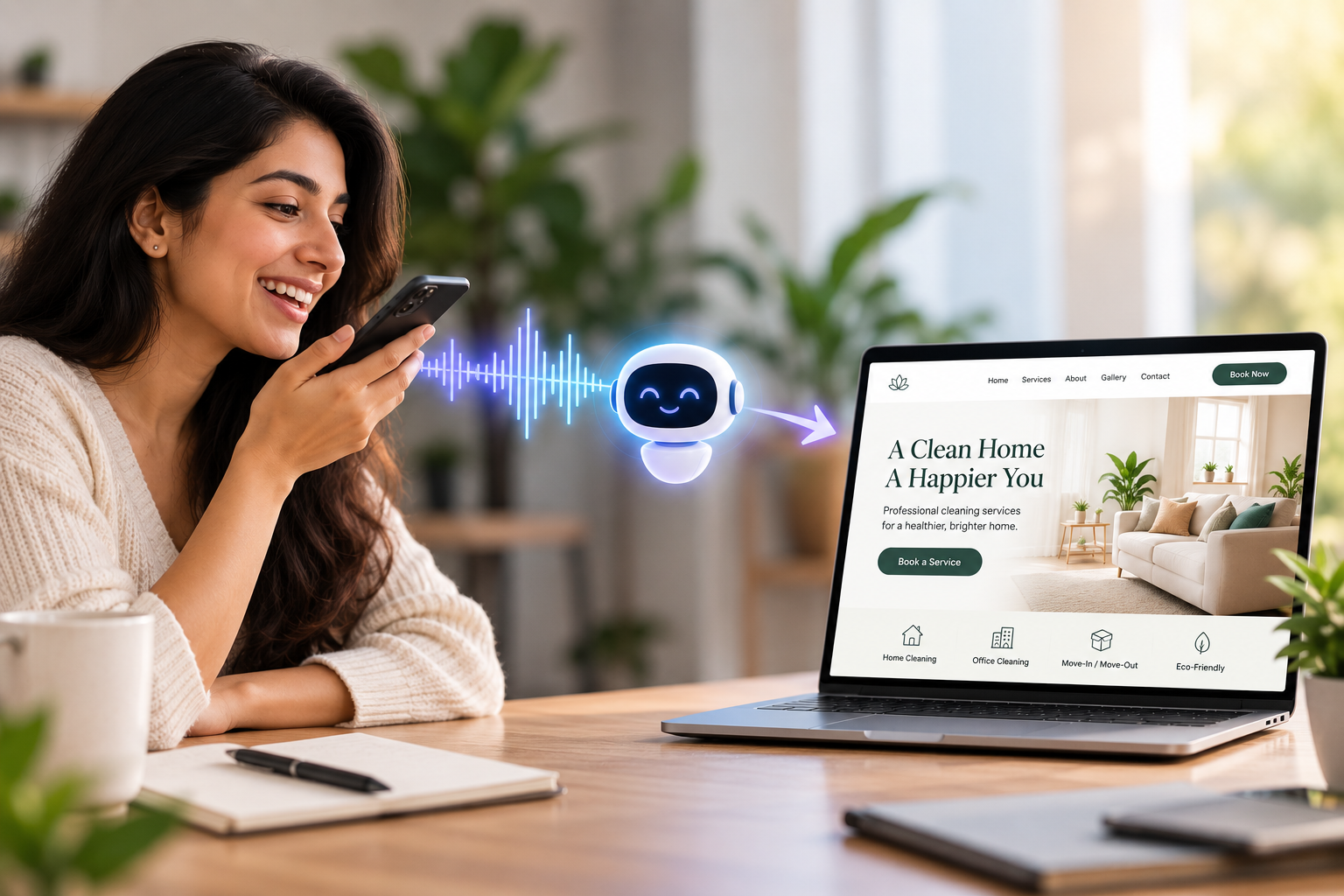
Voice-to-website technology is changing that experience. Instead of learning how to communicate with an AI website generator, you can simply talk naturally about your idea. The AI can understand the conversation, ask questions, refine your requirements, and turn what you say into a working website or app. It is a shift from prompt-based website building to conversational software creation.
What Is Voice-to-Website Technology?
A voice-to-website builder is an AI-powered development platform that allows you to create a website by speaking instead of coding or writing detailed prompts. You might say, “I run a home cleaning business and need a simple website where customers can see our services, check prices, and request an appointment.” The AI can understand the business, identify the important website features, and start creating the experience around those requirements.
The important difference is that voice AI website building isn't simply speech-to-text. A good conversational AI builder should recognize missing information and ask useful questions. Does the business serve one city or several? Should customers call, message, or book online? Are prices fixed? Does the owner need customer reviews on the website? The conversation helps transform a rough idea into clear product requirements.
How Voice-to-Website Works
The experience can be surprisingly simple:
Talk about your idea: Explain your business, website, app, or startup naturally. AI understands the requirements: Conversational AI identifies pages, features, audience, goals, and functionality. AI asks follow-up questions: Missing information can be clarified without requiring complicated prompt engineering. The website or app is built: AI generates the design, content, components, and required functionality. The product goes live: Instead of stopping at an idea or prototype, the experience can continue toward deployment and a live website.
This turns website development without coding into something much closer to having a conversation with a product team.
Why Voice Could Be the Next Step in No-Code Development
Traditional coding requires technical knowledge. No-code website builders removed much of the programming, but users still had to learn drag-and-drop editors, templates, workflows, integrations, and platform terminology. AI website builders simplified things again by allowing users to describe what they wanted through text prompts.
Voice removes another layer of complexity. A restaurant owner doesn't need to understand terms such as responsive design, hero sections, conversion funnels, or frontend development. They can simply say, “I want customers to see today's menu and order through WhatsApp.” The AI website builder can translate that business requirement into the appropriate technical solution.
From No-Code to No-Prompt
The evolution is becoming increasingly natural:
Code → No-Code → AI Prompts → AI Conversations
This matters because people don't always think in perfectly structured prompts. A founder might begin with one idea, change direction while explaining it, remember an important feature halfway through the conversation, and discover another requirement after answering a question. Conversational AI development works with that natural thinking process rather than expecting the user to create a perfect specification before starting.
Build Websites and Apps Without Being Technical
One of the biggest opportunities for voice-based AI development is helping people who understand their businesses but don't understand software development. Small-business owners, freelancers, creators, consultants, restaurants, coaches, agencies, and first-time founders shouldn't need programming knowledge simply to bring an idea online.
This is the approach behind Tikka Burrito. Instead of forcing every user into one way of building, Tikka Burrito allows people to type a prompt, talk with AI through web voice, make a phone call, or communicate through WhatsApp text and voice notes. The goal is to make building a website or app feel more like explaining your idea to someone who understands products and technology.
More Than a Voice Transcription Tool
The important part isn't the microphone. It's what happens after you start talking. Tikka Burrito is designed to have a real conversation around the product idea, understand the requirements, ask useful questions, help refine what should be built, generate the website or application, and deploy the finished product with a live link.
That makes it different from a basic speech-to-text website generator. The broader idea is conversation-to-product: users shouldn't need to convert everything in their heads into technical instructions before AI can help them.
Built for a Mobile-First World
Voice also means website creation no longer has to begin at a desk. A founder could discuss an MVP while walking, a shop owner could explain a new website from their store, or an entrepreneur could work through an idea using a phone instead of waiting until they have access to a laptop.
Combining voice AI, WhatsApp website building, mobile-first development, multilingual AI, AI app generation, and automated deployment could make software creation accessible to people who have traditionally been excluded by technical complexity.
The Future of Website Building Is Conversational
The future of AI-powered website development probably won't be voice instead of text. It will be about giving people multiple natural ways to create. Someone might start with a phone conversation, send additional requirements through WhatsApp, type a specific change later, and use voice again when they want to brainstorm a new feature.
That flexibility is important because the best interface depends on what you're doing. Text can be excellent for precise instructions, visual tools are useful for detailed design changes, and voice can be incredibly natural for brainstorming, explaining problems, and turning an unfinished idea into something concrete.
From an Idea to a Live Product
The biggest change isn't simply that AI can generate code faster. It's that the distance between having an idea and actually building it is becoming much smaller. A person shouldn't need to learn coding, understand complicated prompt engineering, or hire an entire development team just to test whether an idea could work.
Voice-to-website development takes the original promise of no-code one step further. Instead of asking people to learn how software builders work, the software begins learning how people naturally communicate. You talk, clarify, refine, build, and launch.
No-code removed the need to write code. AI removed much of the manual building. Conversational AI website builders may remove the need to know how to build at all.
And that could be the real next evolution of no-code development.